Camera launches still tend to be sold like a scoreboard. More resolution. More frames per second. A larger number on the box.
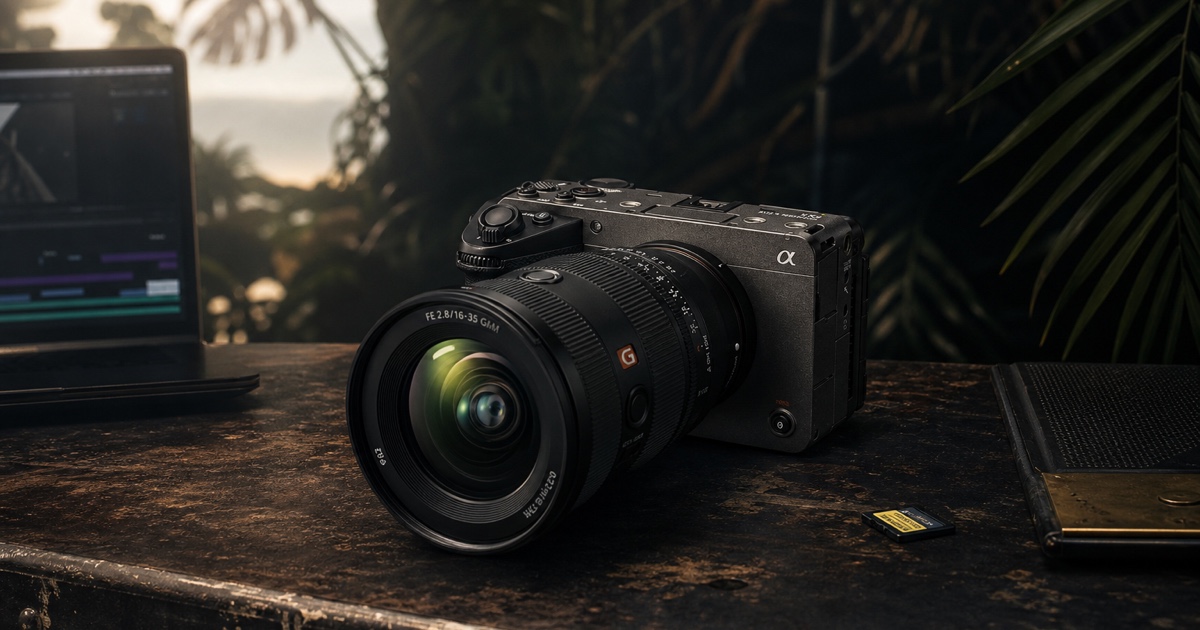
The new Sony FX5 does not play that game. Its headline mode is 5K, not 8K. Yet for the way many of us actually publish content, it offers something more useful: 5K Open Gate recording from the full 3:2 sensor area.
8K gives you more pixels. Open Gate gives you more ways to use the shot.
That distinction is exactly why the FX5 has my attention. I already use the Sony A7R V for photography. What I want beside it is a dedicated video body that lets me record a scene once, then make a proper horizontal YouTube edit and a proper vertical Instagram edit without pretending one awkward centre crop is a creative strategy.
What Open Gate actually changes
Most cameras record video in a wide 16:9 window cut from the sensor. That is perfect if the only destination is a television or YouTube. It becomes restrictive when the same moment also needs to fill a phone screen vertically.
Open Gate records the full height and width of the sensor. On the FX5, that launch mode is a 3:2 frame measuring 4992 × 3328 pixels at up to 60 fps. From that single master clip, an editor can extract:
- Horizontal 16:9: approximately 4992 × 2808, comfortably above a 4K timeline.
- Vertical 9:16: approximately 1872 × 3328, comfortably above the standard 1080 × 1920 delivery used by Reels, TikTok and Shorts.
- Square, 4:5 and other social crops: with more top-and-bottom room than a conventional widescreen source provides.
The resolution is useful, but the extra sensor height is the real trick. It gives you room to move the vertical frame up or down around a person, product or property instead of being trapped inside a thin horizontal strip.
Why 8K does not solve the same problem
To be clear, 8K is not useless. It can provide extraordinary detail, cleaner reframing and more room for stabilisation. An 8K 16:9 image also has enough resolution to produce a high-quality vertical crop.
But resolution and composition are not the same thing. If the camera only records a wide rectangle, the vertical version still has to come from the narrow centre of that rectangle. You can have millions of pixels and still cut off the hand gesture, the villa roofline or the movement that made the shot work.
Open Gate changes the capture decision. I can frame with both destinations in mind, keep more image above and below the subject, and decide the final composition later. For a solo creator, a travel filmmaker or a small crew delivering several platforms, that flexibility is not a laboratory benefit. It saves reshoots, duplicated takes and compromised crops.
One shoot, two edits — with one important condition
Open Gate is not magic. You still need to compose for both formats. A subject placed hard against the left edge may look great in a 16:9 edit and disappear from the vertical version. Fast camera moves can also leave the social crop with nowhere useful to go.
The sensible workflow is to monitor or imagine a central 9:16 safe area while still building a wider frame around it. Keep the essential action inside that safe area; use the surrounding width for context in the YouTube version. When the scene truly needs two different compositions, shoot two takes. The point is not to ban deliberate coverage. It is to stop creating extra coverage simply because the camera threw away the top and bottom of the sensor.
The rest of the FX5 is serious too
Sony announced the FX5 on July 22, 2026 as a new model between the FX3 and FX6. It uses a newly developed 16.6-megapixel full-frame stacked Exmor RS sensor with the BIONZ XR2 processor and a dedicated AI unit.
There is also five-axis in-body stabilisation, an active cooling fan for long recording sessions, AI-assisted autofocus, dual CFexpress Type A / SDXC slots, false colour, waveform and vectorscope monitoring, and support for an optional OLED viewfinder.
The new XLR-H2 handle adds up to four-channel audio with 96 kHz, 32-bit float recording. For documentary, interview and hospitality work, that is a meaningful option rather than a decorative handle.
The launch caveat creators should know
At launch, Open Gate is available only when recording X-OCN RAW. That gives you excellent post-production latitude, but it also means CFexpress Type A VPG400 media, larger files and a more demanding edit workflow.
Sony says firmware version 2.0, planned for 2027, will add 3:2 Open Gate recording in XAVC S-I, an interface optimised for vertical shooting and additional high-frame-rate options. Do not buy the camera today on the assumption that a future feature is already in the menu.
The FX5 also does not replace the FX6 for every job. It lacks the FX6’s built-in variable ND and SDI connectivity. If those are daily requirements, the larger body still earns its place.
Sony FX5 price in the US and Australia
| Configuration | United States | Australia |
|---|---|---|
| FX5 body only | US$4,899.99 MSRP | A$7,849 advertised |
| FX5 with XLR-H2 handle | US$5,499.99 MSRP | A$8,849 advertised |
Sony’s US announcement says both configurations are expected in mid-August 2026. Australian retailers including Camera House and Videoguys Australia were taking pre-orders at the prices above, with stock expected around August. Retail pricing and availability can move, so check again before ordering.
Why it fits the kit I am building
The A7R V already gives me the high-resolution stills body I want for photography. I do not need my next camera to win the same argument again. I want it to be built around motion: dependable long takes, useful monitoring, internal RAW, better high-frame-rate options and a frame that can survive several delivery formats.
The FX5 looks like that camera. The 5K specification will not dominate a comparison chart beside 8K bodies, but the Open Gate frame is closer to the actual problem I need solved.
I have not shot with the FX5 yet, so this is not a review. It is the reason the camera is now at the top of my video wish list. Hopefully I will be adding one to the kit soon — and when I do, the first test will not be a resolution chart. It will be one real scene, finished twice: horizontal for YouTube and vertical for Instagram.
Sources and notes
- Sony Electronics FX5 launch announcement, July 22, 2026.
- Sony Australia FX5 product page.
- Camera House Australia FX5 body listing, checked July 25, 2026.
- Videoguys Australia FX5 first look and pricing, checked July 25, 2026.
- Feature image is original AI-generated editorial artwork created with GPT Image 2 using Sony’s official product image as a visual reference. It is illustrative, not a product photograph.